
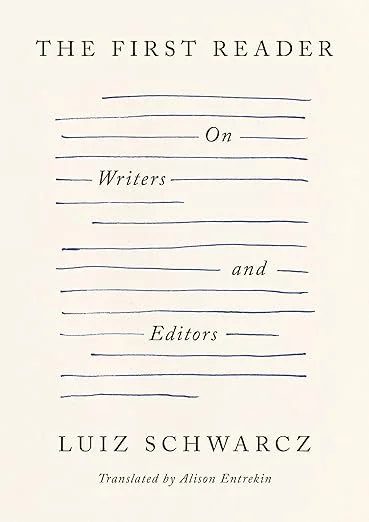
The First Reader
On Writers and Editors
By Luiz Schwarcz
Translated by Alison Entrekin
Penguin Press, October 6, 2026
From one of the world’s most celebrated literary publishers, a beautiful and candid meditation on the art of being a partner to creative greatness
For 40 years, Companhia das Letras, the Brazilian publishing house founded by Luiz Schwarcz, has stood for a steadfast and imaginative commitment to its authors and their books. As its reputation grew, the house became the home of an increasing share—and eventually an astonishing one—of globally important writers.
That special responsibility has given Schwarcz and his colleagues a unique vantage on the craft of being a good partner to a creative force. It is a particular kind of dance, involving diplomacy, fierce commitment, humility, attention to detail, and an intuitive feel for the coherence of the book as both text and physical object. It’s a delicate matter even when both parties are at their best, which is inevitably not always the case. And unlike other dances, it takes place in silence, a special kind of silence that forms a channel between that of the writer and that of the reader.
In The First Reader, Schwarcz offers up insights and stories that bring this special relationship to life. He writes with delightful candor about some of the world’s greatest writers and trickiest personalities, always at heart retaining his honest love and reverence for what these artists can do, and what they can mean in the world. For anyone involved in the practice of creative collaboration, in any medium and on any level, the book is a master class, and a source of inspiration and delight.
Selected Praise for The Absent Moon
“Marked by a clarity that comes from total, rigorous precision… [The Absent Moon] reads like a liberation, not just from the form of the next-generation Holocaust memoir but also from the assumption, so common in autobiographical writing, that memory should create meaning… The Absent Moon is, for all its restraint, a profoundly emotional book, and a brave one.” —The New Yorker
“Luiz Schwarcz’s talents are well-known in his native Brazil, but now all of us can benefit from his captivating prose and incisive emotional dissection… Slim, small, and searing, this quiet-looking book packs an enormous punch.”
—Good Morning America
“This is a story of intergenerational pain and its reverberations in everyday life. Throughout the memoir, we see a boy, a teen, and a man fighting demons—others’ and his own. That fight is sometimes successful, sometimes not, but it’s always deeply human.” —Jewish Book Council
“A Brazilian writer and publisher memorably chronicles his Jewish upbringing in São Paulo as an only child plagued by depression. In this beautifully composed narrative, Schwarcz investigates the undigested trauma from his postwar childhood, a time shadowed by the long-lasting guilt and depression of his Hungarian Jewish father, András… These stories will resonate with anyone dealing with depression, anxiety, mental illness, and/or generational trauma. A riveting literary memoir.”
—Kirkus, starred review
“In this intimate and profound description of a life often marked by depression, Luiz Schwarcz touches on the insidious power of intergenerational trauma; on the terrible challenges of functioning despite a crippling disease; and on the burden of carrying a disability in relative silence. His is ultimately a book about identity, about how the author has managed, both despite and because of his depression, to inhabit a good marriage, an excellent career, a lovely family, and, perhaps most crucially, a coherent sense of self. It is written with spare economy, tremendous bravado, and authentic courage. It is generous in spirit, devoid of self-pity, and an authentic literary achievement.” —Andrew Solomon, author of Far from the Tree
“A beautiful work that is in turn haunting, touching, and redemptive.”
—Simon Sebag Montefiore, author of Stalin: The Court of the Red Tsar
“This tender and lovely memoir of a child growing up in Brazil in a household whose characters were scarred by the Holocaust is unlike anything I can think of. It is also a lyrical and intimate portrait of the author’s lifelong, harrowing battle with depression.” —Abraham Verghese, author of Cutting for Stone
About the Author
Luiz Schwarcz was born in São Paulo, Brazil, in 1956. He began his career as an editor at Brasiliense and later founded Companhia das Letras, in 1986. In 2017, he received the London Book Fair Lifetime Achievement Award. He is the author of the children’s books Minha vida de goleiro (1999) and Em busca do Thesouro da Juventude (2003), and the short story collections Discurso sobre o capim (2005) and Linguagem de sinais (2010).
Buy This Book